
Two women left Hong Kong for Canada at different times to escape Chinese repression.
by Rachel Saarony
On the night of June 4, 1989, 27-year-old Aurelia Wong sat on her family’s apartment floor in Hong Kong’s Southern District watching China’s military massacre its own people live on television. Her father, Raymond—a salt-and-pepper–haired trading middleman who brokered deals between foreign firms and mainland Chinese government officials—went still, eyes fixed on the screen. He had long believed Hong Kong’s economic importance would protect it after Britain returned the autonomous region to Chinese rule in 1997. That night, his faith collapsed.
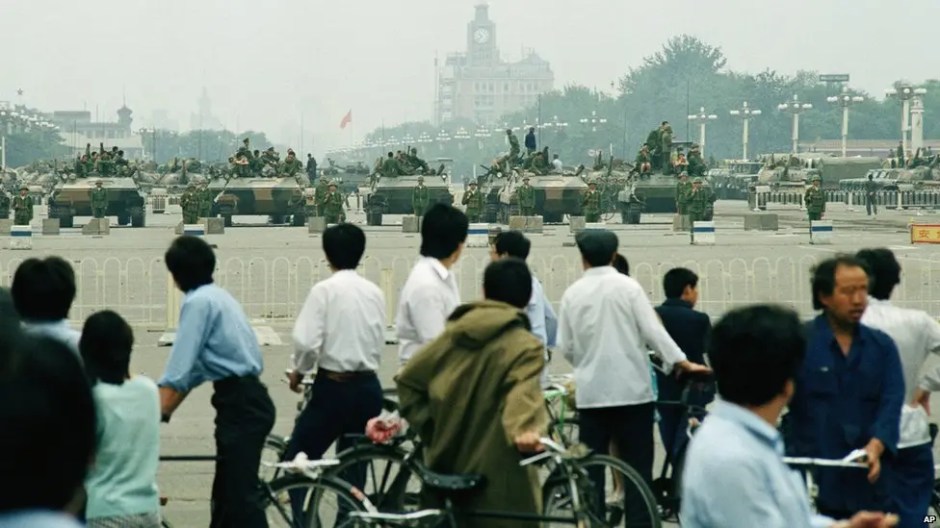
On-screen, armoured vehicles crushed makeshift barricades of bicycles and buses in Tiananmen Square, the symbolic heart of China’s political power. For six weeks, more than a million people had occupied the plaza, the CBC reported, demanding democratic reform and an end to corruption. The government had issued its ultimatum, but protesters stayed. Now, about a hundred tanks rolled in from multiple directions, flattening a sea of tents.
Columns of soldiers swept through the surrounding avenues, under orders to clear Tiananmen by any means. Gunfire and sirens wailed across the square. Protesters scattered through smoke and tear gas—some bloodied, others carrying the wounded. “People used to say the soldiers had red eyes, like they were on drugs,” Aurelia recalls. “We couldn’t believe how anyone could do those things.”
Though Hong Kong was still eight years away from its handover to China, under the promise of “one country, two systems,” Raymond pleaded with his daughter that night. “You have to leave. You can come back anytime—but after [the handover], there might not be another chance to leave safely.”
Three months later, Aurelia and her boyfriend, Peter Wong, quit their jobs, shipped a mattress and dining set, and packed two suitcases for Toronto. Aurelia was one of roughly 150,000 Hong Kongers who moved to Canada between 1989 and 1997, according to Statistics Canada, as Tiananmen shattered confidence in the city’s future. If the state could open fire on unarmed pro-democracy civilians, what protection would Hong Kong’s freedoms—speech, assembly, an independent judiciary—really have? With limited savings and one contact in Canada, they boarded the plane, unsure whether they were leaving for good. “I had this opportunity by chance and circumstances,” she says now.
Thirty-five years later, a second wave is settling into Canada. Since Beijing imposed the National Security Law in 2020—criminalizing dissent, dismantling press freedom, and jailing pro-democracy advocates—advocacy groups like Hong Kong Watch estimate more than 60,000 Hong Kongers have arrived through special immigration pathways. In both 1989 and 2020, Canada’s response was humanitarian in spirit but economic in structure, offering opportunities through investor visas and skilled worker programs.
If Aurelia Wong represents the first wave, her niece, Violet Chan, arriving in Vancouver in 2021, represents the second. She grew up believing Hong Kong’s freedoms would last, built a life there as a social worker, and then watched, in 2019, as the city she knew began to collapse.
This is a story about two waves of Hong Kong migration to Canada—one that began in fear of what might come and another driven by what already has—and how, a generation apart, the same journey can mean something entirely different.
HONG KONG had been leased to Britain for 99 years under the Convention of Peking, a treaty signed in 1898 that secured the UK’s control over the territories surrounding Hong Kong Island following China’s defeat in the Second Opium War. By 1982, negotiations over its return to China in 1997 were underway. After a failed meeting with Chairman Deng Xiaoping in Beijing, then British Prime Minister Margaret Thatcher slipped on the steps of the Great Hall of the People. Hong Kong’s superstitious press declared it an omen: the Iron Lady had bowed in surrender.
This horrified Aurelia’s paternal grandmother, Nelly Espinas—formerly Nelly Wong before remarrying. She had fled revolutionary China, been separated from her first husband, and rebuilt her life in Hong Kong with a Filipino man named Eduardo Espinas. Appalled by Chinese Communism, she refused to set foot on the mainland again. “She always said China was not secure,” Aurelia recalls. “One day you’re fine. The next, you’re gone.”
Nelly’s instincts would prove prescient. In 1986, Aurelia worked at a restaurant management company in Repulse Bay, one of Hong Kong’s most affluent neighbourhoods. The company’s driver, whom she knew as Mr. Hong and whom Aurelia befriended, badgered her daily. He regularly went to the Canadian Chamber of Commerce and had little faith in Beijing’s promise that Hong Kong would maintain a “high degree of autonomy” for 50 years, as outlined in the 1984 Sino-British Joint Declaration. “Keep your doors open,” he told her. Eventually, she applied.
When Aurelia mentioned the application to her father, Raymond scoffed. “If you go there, you’ll be a beggar.” In May 1989, her approval arrived in the mail. She had no intention of using it—until Tiananmen happened.
IN the mid-to-late 1980s, as uncertainty over Hong Kong’s future mounted, Canada’s federal government began actively courting Hong Kong’s educated professional class. Yves Tiberghien, a professor of political science at UBC and director emeritus of its Institute of Asian Research, closely watched this targeted recruitment of wealthy, skilled emigrants. In 2019, he wrote in the Daily Hive, an online newspaper based in Vancouver, that after the 1989 Tiananmen Square protests, this steady stream of arrivals “turned into a mass migration flood,” funnelling significant capital and talent into Toronto and Vancouver.
These Hongkongers were the ideal immigrants for Canada’s points-based system: young, educated, English-speaking, and highly credentialed. However, Canada was less prepared for the social and economic complexities they brought with them—specifically their transnational lifestyles, where families maintained homes and businesses in both countries simultaneously; “astronaut” family dynamics, in which one parent remained working in Hong Kong while the rest of the family settled in Canada; and deep-seated political anxieties regarding the Chinese handover.
One of those arrivals was Aurelia, who landed at Toronto Pearson International Airport on October 15, 1989, with her boyfriend, late at night. Her sole contact in Canada was a friend-of-a-friend’s sister in Scarborough, from whom she rented a basement for three months.
The drive from the airport that night was Aurelia’s first glimpse of Toronto. “There was nothing out the window,” says Aurelia. “No lights, no tall buildings. Compared to Hong Kong, you don’t call that a city.”
The disorientation continued the next day when she experienced Toronto transit. Unlike Hong Kong’s point-to-point buses, Toronto’s grid system required riders to transfer at intersections, waiting outdoors in the cold. “That was beyond my comprehension,” she says.
Four days after arriving, Aurelia interviewed at Federated Customs Broker, a firm managing cross-border paperwork, and was hired immediately as an administrative assistant. “At the time, if you wanted to work [in Toronto], you could find something fairly easily,” she says. She remembers walking into a bank and being asked, “Are you looking for work? Would you like a job here?” as they were short-staffed. “I should have accepted and been a teller because they had benefits,” Aurelia half-jokes. “But we didn’t know what benefits were.” Within two years, after night school courses and certification exams, she became a customs specialist—one of her proudest professional achievements.
On November 3, Aurelia married Peter Wong so he could secure permanent residency. He had been a real estate agent in Hong Kong and had found work in Toronto as a property manager; but without his own landed-immigrant status, Peter would have had to leave Canada. “It’s like our path was already written,” says Aurelia. “We had been together three years back home but married quickly [in Toronto] out of necessity. We never ended up having a wedding ceremony.” Soon after, when their three-month basement rental ended, they rented a small apartment downtown within walking distance of her office.
IN the 1990s, the work culture in Toronto was completely different from that in Hong Kong. In Hong Kong, Aurelia was expected to stay after hours, often until 8:00 p.m., without complaint. In Toronto, hercolleagues often left at 4:15 p.m., some to catch the GO train. For Aurelia, staying late was second nature, which made her stand out. Within months, she earned more than colleagues who had worked there for years.
To save faster, she took a second job at a German logistics warehouse, Kuehne + Nagel—working midnight to noon on Fridays and Saturdays, running reports for Sears Canada, a department store chain. She paid off her car in two years and bought a house in Markham. In 1992, Aurelia received her citizenship and sponsored her parents. Raymond, fluent in English, adjusted quickly. Yau Fuk Yau, her mother, who spoke no English, found her footing in Agincourt, a Chinese ethnoburb where she could navigate daily life, take community buses, and play mahjong. “Once my parents came,” Aurelia says, “there was no reason to go back to Hong Kong. Our new life was here.”
Her friends from Hong Kong arrived in slow waves. Aurelia bumped into an old classmate in a supermarket; she tracked down a childhood friend using only a Christmas card address and built new connections through church. Aurelia and her friends met on weekends to play mahjong and go line dancing on Saturdays at a community centre in Scarborough. “We had nothing at first,” she says, “but we built a home and community little by little.”
On November 19, 1994, Nicholas Wong was born. He is now 31 years old, almost six feet tall, and has his grandfather’s salt-and-pepper hair—a trait that appeared when he was around ten. He still lives at home and comes thundering down the stairs to announce, failing to sound casual, that he has just been promoted to financial manager at Constellation Software, Canada’s second-largest technology company.
When Nicholas was nine, his parents invested in dot-com tech stocks, watching numbers rise intoxicatingly fast—then the market collapsed and they lost everything. His father, Peter, devastated, sought solace elsewhere—an affair that ended the marriage. A year later, he returned to Hong Kong, leaving his son behind. Since then, he has made no effort to see Nicholas, marking his existence only with yearly birthday messages. “Canada is a hamster wheel,” Nicholas says. “You live paycheque to paycheque. If you’re lucky, you save a little.”
Aurelia, now a single mother with her ailing father cycling in and out of hospital, worked from nine to eight at the customs brokerage firm where she had spent most of her career. Nicholas walked home from school alone and raised himself on the early Internet: “I was basically an unsupervised 10-year-old online. But that shaped how I function today.” The thousands of hours gaming—learning to coordinate, negotiate, and problem-solve with strangers across time zones—taught him the tech fluency and transferable skills that helped him break into finance after graduating from Toronto Metropolitan University in hospitality andtourism management in 2017, a degree he credits with little; what got him into finance, he says, was strategy and the willingness to act more confident than he felt.
In high school, Nicholas had focused on assimilating. He begged his mother to stop packing him lunches, as her home-cooked dishes drew too much attention in the cafeteria. When she asked him to wear traditional clothing for Chinese New Year, he refused. “I told her, ‘I’m not Chinese, I’m Canadian!’ I think that broke her heart for a day.”
Young Nicholas’ reaction reflects what UBC social work professor Miu Chung Yan describes as “dual identity.” Yan, who has studied multiple generations of Hong Kong immigrants in Canada, has found that many second-generation Hong Kong-Canadians distinguish themselves from local Chinese by embracing Canadian values. They often feel a strong sense of Canadian identity, especially when faced with challenges from both outsiders and family members. “When you’re placed in an unfamiliar situation, you start searching for your own identity,” he says. “Canadian culture becomes a framework for defining oneself.” Nicholas says he didn’t want to be perceived as different or an outcast among his peers, leading him to outright reject and despise his Chinese heritage.
In hindsight, he now understands the significance of tradition for his mother. “There are values underneath the traditions,” he says. “Community. Family. Taking care of people around you. Those values are severely missed in North American society—where everything is ‘me, me, me.’”
WHEN Aurelia left Hong Kong in 1989, her niece, Violet Chan, was five years old. Violet grew up believing the city’s freedoms would endure for 50 years, as per the 1984 treaty. She built a stable life as a social worker in Mong Kok, on mainland Hong Kong, where her aunt used to live, helping university students navigate crises.
Now 40 and living in Vancouver, Violet has a gentle face and sleek ebony hair. On a FaceTime conversation in November 2025, she recalls Hong Kong with a hint of longing. “Everything was convenient and comfortable,” she says. “The transit was efficient; the food was cheap and good. You could get whatever you needed easily.”
The first cracks in Hong Kong’s promised autonomy appeared in 2014, when Beijing pushed a national education curriculum critics said was designed to instill loyalty to the Communist Party. In 2019, a proposed extradition bill that would have allowed Hong Kong residents to be tried in mainland Chinese courts brought millions to the streets, Violet among them. What followed shattered her faith in the city’s institutions: police allegedly cooperating with triad members attacking commuters in metro stations; social workers arrested for mediating between protesters and police; speech therapists convicted for using a children’s book that employed animal metaphors to describe the political situation. Even certain songs were banned.
“You [didn’t] know what [was] safe anymore,” Violet says. “What you say. What you post. Even what colour you wear.” Black became associated with protesters; wearing it in the wrong neighbourhood, at the wrong time, could mean a beating or an arrest. On July 21, 2019, Violet’s husband, Howard Chan, a Vancouver-born Hongkonger-Canadian, was in the Yuen Long district when police and triad members stormed the station. They had a friend inside—an older woman in a neutral dress—who was allowed safe exit, while younger people were detained and assaulted.
In June 2020, Beijing imposed the National Security Law, criminalizing secession, subversion, and collusion with foreign forces. In March 2024, the legislature passed Article 23, a further ordinance whose potential penalties include life imprisonment. By late 2024, 45 pro-democracy advocates had been sentenced for their involvement in a peaceful unofficial primary election; new arrest warrants were issued targeting advocates living abroad.
By the start of autumn in 2019, Violet decided she could no longer stay. She spent two years preparing to leave. She arrived in Canada in 2021, settling in Vancouver with Howard, who had come home. Aurelia left because a door opened and her father pushed her through. Violet left because every other door had closed. “If the law allows [the Chinese government] to come after you in other countries,” Violet says, “there is no safe place. You have to go where you have rights.”
OVER the phone from Vancouver, Violet’s voice overlaps with Aurelia’s in the room—the two women finishing each other’s sentences, adding context, correcting dates, and laughing at the same memories from opposite sides of the country. They discuss their different experiences adapting to Canadian culture, which was harder for Violet. In Hong Kong, efficient trains and minibuses make driving unnecessary. Violet failed her driving test four times before finally passing on the fifth attempt.
Aurelia had more exposure than Violet to foreign companies and their cultures when she lived in Hong Kong; and, her multilingual family ensured she spoke common-tongue English. Violet, on the other hand, learned to navigate Canadian culture largely through trial and error.
“In Hong Kong, we learn book English, not slang like ‘get the ball rolling.’ I didn’t know that,” Violet says. In her first weeks working as a career counsellor at WorkBC, a client asked about forklift training. Violet heard something else entirely. “I heard ‘fuck-leave, so I had to ask them to write what they said.”
UBC social work professor Miu Chung Yan, who surveyed 660 Hong Kong arrivals to Canada, found in his 2023 report that most “can only rely on their own skills and informal networks to resolve the many difficulties in the settlement process.” Government-funded settlement services are limited to permanent residents; the majority entered on temporary permits and navigated early resettlement alone.
People who arrived during the immigration waves, like Aurelia and Violet, came with various intentions. The first arrived during Hong Kong’s boom years, many treating Canada as a contingency—a passport kept in reserve, retrievable if the handover turned hostile; a significant portion returned after 1997 passed without catastrophe. The second wave came to stay. They left Hong Kong because staying became untenable. As Yves Tiberghien wrote in 2019 in the Daily Hive, “After June 4, the well of goodwill and trust between the Mainland and Hong Kong was poisoned.” What Tiananmen poisoned in 1989—the fragile trust that Beijing would keep its promises—the National Security Law killed in 2020.
Yan’s 2025 follow-up report found that despite the hardships, the new arrivals hold “an unanimously positive perspective” of their relationship with Canada. Unlike the first wave—many of whom moved fluidly between Hong Kong and Canada before settling quietly into the broader Chinese diaspora—this group is building something distinct. They call themselves Hong Kong-Canadian, an identity that is politically engaged, conscious of what was lost, and unwilling to be folded into a category that includes the government responsible for their displacement.
ON a frosty 2026 afternoon in Markham, where Aurelia, now 64, has built her life, houseplants spill in every direction, turning her living room into a small indoor forest. She is small and, from a distance, her fiery golden-brown eyes might read as stern; up close, that impression melts. What stands out instead is her firecracker liveliness. Aurelia’s 87-year-old mother, Yau Fook Yau, shuffles beside her to set a plate of sliced apples on the table, her oval face, softened by age, illuminated by a broad, wordless smile.
Aurelia’s 65-year-old partner, Niccolò Del Giudice, steps inside, carrying an emerald-green peacock-embroidered sari. He looks like a shorter, warmer, and less intense version of the Italian actor Pierfrancesco Favino, whose numerous film credits include Night at the Museum and World War Z; he has neatly parted, straight grey-black hair and an easygoing, friendly smile. The couple are preparing to travel to India for the wedding of his son, Marco, with a stop in Hong Kong to visit Aurelia’s sisters, Esther and Margaret.
When Aurelia returned to Hong Kong in 1992 for the first time, a few years after immigrating, the city moved at a faster speed she no longer recognized. Her sister had to hold her hand to cross the street. “Run!” Esther said, pulling her into traffic. “I’d forgotten how to cross the road there,” says Aurelia. “I’d already learned to live at a slower pace.”
In Vancouver, 41-year-old Violet is still finding her place. On October 7, 2025, she became a Canadian citizen. Today, Violet works as a social worker for the Canadian government while studying for a higher-level certification in youth and family support. Her degree from the University of Hong Kong, like many foreign credentials, does not fully transfer in Canada’s regulated system, requiring additional local training before she can advance.
“I always count my blessings,” Aurelia says. “There was always an angel leading my way. Whenever I needed something, someone appeared to help.”
Immigration is often referred to as a new beginning, but both Aurelia and Violet describe it differently. It is loss first—of language, certainty, and the life people once had. What follows is the arduous work of rebuilding a world and community, piece by piece, until something unfamiliar begins to feel like home. For Aurelia and Violet, that process took decades, through labour and faith. Aurelia, whose spirituality never wavered through divorce, her father’s illness, and solitary sacrifice, may recognize that, like those who wandered before finding their promised land, what they lost in leaving made room for something Hong Kongcould no longer offer them: the freedom to build a life on their own terms.
Rachel can be reached at: rachelsaarony@gmail.com
 thescribbler.ca