
How my mother’s mental illness shaped me
By Violet Stec
The first time I remember feeling responsible for another person’s emotions, I was still a child. It was 2014 and I was 10 years old when my mom, Julita, burst into tears in the middle of a park. I was hanging out with my childhood best friend, Margaret. The park was a short distance from my house, and my mom and I had walked over there. I hadn’t caught wind of her mood that day—I was too excited to see Margaret. About halfway through our hangout, as we were running erratically around the park, my mom began to sob, loud and unashamed. People turned to look, and I ran to comfort her, but she was inconsolable. Margaret and I were unsure of what to do. Finally, Margaret called her mom, who arrived minutes later; our peaceful afternoon was punctured. I walked my mom home, making desperate promises of good behaviour and better grades. I was sure I had caused her outburst; I had this deep nagging feeling that I had not done enough. I had made her sad. Looking back now, I realize that for the first time I knew for certain something was wrong; my mother had some form of mental illness.
As my mother’s mental health worsened, it became my childhood responsibility to take care of her. I seemed to be the only one who could pull her out of her unpredictable moods. Having recently turned 21, I recognize how taxing this role was for me, and how deeply affected I was by my childhood experiences and complex family history.
My childhood memories are patchy. Some moments emerge vividly, while others are barely there. I recall trying to reach out to my mom, now 47, and feeling there was a barrier keeping us apart, something I could physically feel. I could never get close enough. What I recollect the most were the empty stares, the lack of movement, the cold indifference. And then the occasional frantic energy, with so much talking I could hardly keep up. My least favourite was the whispering at night, the banging downstairs, and sometimes her leaving the house, barefoot and in her pyjamas.
I don’t remember if my grandparents, Elzbieta, now 71, and Wieslaw Stec, now 73, who lived with us, had called the police or went out to look for her. I just have an image of being ushered to bed, and by the time I woke up for school, she was home.
For most of my childhood, it was just my grandparents and me. My father, Patrick Shirley, now 60, kept very little contact with me. My mother had left him shortly after I was born, before her downward progression.
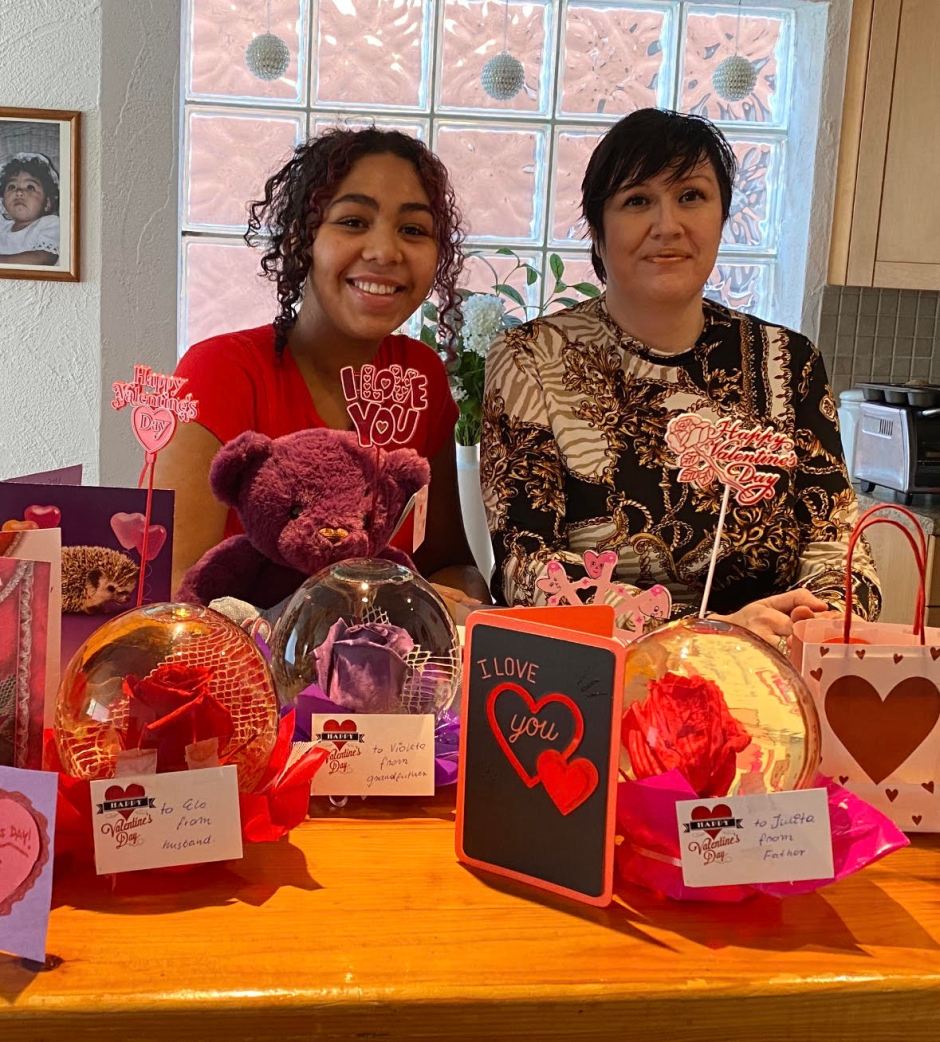
My mother is a pale woman with brown eyes, short black hair and thin eyebrows. A first-generation immigrant from Poland, she grew up in Warsaw. She came to Canada in 1988 at age 10 with her parents. They moved to Mississauga, settling in a quaint semi-detached house in a developing suburb, where they still reside.
My mother was diagnosed with multiple mental illnesses over the course of her life—depression, bipolar disorder, schizophrenia, and finally, a mix of all the above: schizoaffective disorder. According to the Schizophrenia Society of Canada, it’s a combination of a mood disorder, such as bipolar, as well as schizophrenia.
My mother still has fluctuating moods and varying hallucinations. She has periods when the hallucinations become worse or better, and she also has periods of a “flat affect” when she seems not to have any emotions at all. There is no specific cause for the disorder; it can emerge as a combination of genetic factors and environmental influences. She first began having symptoms in her early twenties, but they only began to worsen after having me, possibly due to the stress of pregnancy and motherhood.
Until that day in the park, no one in the family had spoken about my mother’s condition to me. It was only after I returned home that my grandmother sat me down and told me a watered-down version of my mom’s condition.
My grandmother, Elzbieta, was born in October 1955; she is now a small, frail woman. Her curly hair, which she still colours herself at 71, is a bright red, matching my own dyed head. Her husband, Wieslaw, sports close-cropped white hair and a thin mustache.
Elzbieta stepped in as my mother for my childhood and some of my teenage years. She juggled raising me and keeping up with my mom. She describes the days before my mom was stable as jarring and unpredictable. “There were many times when she would just leave, unexpectedly in the middle of the night, and wouldn’t come home for days,” she says. “Then, just appear at the front door. I never knew where she went, or why.” This is a rough translation of Elzbieta’s words in Polish. Despite leaving Poland at age 33 and spending over 35 years in Canada, her English is still rough around the edges. When she speaks, her voice is sweet with a quiet sense of authority, like that of a teacher.
My grandfather, born February 5, 1953, was often gone. He owned a painting and wallpaper business, Willy’s Custom Painting & Wallpaper, and worked hard to make the money stretch. This left my grandmother to take care of me and all the aspects of the house, but it was my role to comfort my mother. My grandmother was a hard woman, unemotional and strict. She often didn’t know what to do with my mom’s emotional outbursts. She only knew that I could make her feel better and would often send me to check on her. I became my mother’s sole support at home.
This impacted me in many ways: from childhood, I was often awake most of the night, my stomach a pit of anxiety as I waited for something to happen. Even though my mother’s somewhat frequent disappearances stopped when I was around 16, my anxiety hasn’t lessened. I struggled greatly with depression and anxiety throughout high school; they continue today. My body remains tense, despite the relative peace that has settled in recent years.
Dr. Bessel van der Kolk, a Dutch-American psychiatrist, author and researcher who published The Body Keeps the Score: Brain, Mind, and Body in the Healing of Trauma in 2014, recognizes the amount of time it can take for true healing after a traumatic event. “The essence of trauma is that it is overwhelming, unbelievable, and unbearable,” he wrote. “Each patient demands that we suspend our sense of what is normal and accept that we are dealing with a dual reality: the reality of a relatively secure and predictable present that lives side by side with a ruinous, ever-present past.” I like to think that the worst is behind me. That with my mom remaining relatively stable, I can finally move forward. But, in truth, the impacts of the past are still present in my daily challenges.
I struggle with finding my own identity, something common for people my age, but I feel uniquely behind in this process. I have never felt a strong sense of identity; I have only understood that I was meant to be there for my mother.
This lack of identity is not uncommon in children of mothers with mental illness, as American psychologist Susan Nathiel explores in her 2007 book, Daughters of Madness: Growing Up and Older with a Mentally Ill Mother. In her interviews with adult women who have grown up with mentally ill mothers, they often talked about not understanding who they are, as that part of their personality had little time to develop because of family instability. I relate to them a lot—this sense of not knowing myself has been especially noticeable since starting university, while surrounded by so many passionate, creative and curious people. They all seem to have this inner force, this drive and knowledge of themselves that I am just now starting to grasp. Nathiel describes how our childhood experiences create our “coherent, continuous, and unified implicit sense of self.’’ Our most fundamental feelings of who we are is typically derived from a caregiver, usually a mother. Our sense of self is dependent on the connections I rarely had.
To supplement those connections, I relied on other people. In high school, I only had one or two friends at a time. I connected with them deeply and intensely. We would see each other every day, call for hours on end, and spend every waking moment around each other. This unhealthy immersion is something I still struggle with. Often, my identity becomes wrapped up in another person, similar to how I am with my mother. This intense attachment is called anxious attachment.
The concept of attachment, specifically in mother-infant relationships, was explored in 1969 by John Bowlby, a pioneering British psychologist. He examined how children can become securely or insecurely attached to their caregivers. In 1978, Dr. Mary Ainsworth, a Canadian-American developmental psychologist who observed infant behaviour, suggested that there are three kinds of attachment: secure (healthy attachment), anxious attachment (need for intense closeness) and avoidant attachment (discomfort with closeness).
In describing the core of all insecure attachments, Bowlby said: “An insecurely attached person may view the world as a dangerous place in which other people are to be treated with great caution and see himself as ineffective and unworthy of love.” This provides some insight into one of the many impacts on my psyche. The lack of stability in my childhood contributes to an intense need to connect with others, one I am just now trying to heal.
Even with the challenges resulting from my relationship with my mother, I still feel a deep sense of love and care for her. When my mother talks about her experiences and childhood, I feel compassion more than anything else.
I know my mother’s life had not been easy. She describes her childhood as neglectful. She was fed and clothed but living in Communist Poland was difficult. Money was hard to come by and her father worked often. She rarely saw him. Her mother, hardworking by nature, was not the nurturing kind. She did not enjoy staying home and taking care of her daughter; she would often yell and drink and hit her if she misbehaved.
My grandmother describes her parenting in an over-inflated way. She talks often about respect, and how lenient she considered herself as a mother in comparison to her own upbringing. Though she speaks about her mother, Nushia Jagelowicz, with warmth, she does not describe her as particularly loving. Nushia, who passed away in 2021 at age 84, was a practical woman who kept things in order and made sure everyone was fed. Much like Elzbieta, she was not the nurturing type. Elzbieta also mentions that she was often beaten with a belt by her late mother for misbehaving.
The descriptions of my great-grandmother gave me pause, as they sounded eerily similar to my mother’s childhood. This interlinking of experiences across two generations is described as intergenerational trauma, which is very applicable here. This idea describes how trauma is passed on from generation to generation, with the physical and mental impacts lingering for generations to come.
In some ways, understanding these details about my mother’s life has helped me understand my own. My childhood sometimes mirrors hers; she was extremely shy and anxious until high school. Then she branched out, which later led to long episodes of staying out all night, skipping classes, and excessive drinking. She went through a myriad of boyfriends, finally meeting my father, Partrick, when she was 19 and he was 34. Now 63, he’s short and dark-skinned, with a nearly bald head. He and my mother were together for eight years, though never married, breaking up shortly after I was born, when my mom was 27.
My mother doesn’t often talk about how they broke up. She describes it as a manic flurry. She was not aware that she wanted to leave him until one specific night. Nothing had prompted this idea; she had simply had enough. Bored and tired of living at their apartment in Etobicoke, she had never longed to go home before, but she felt like she couldn’t stay there. She called my grandparents in the middle of the night, and they picked her up from the house when I was a few months old. She never went back. Nor did she date after that; she didn’t want to go through another heartbreak.
After leaving, she moved in with my grandparents, and as her mental illness spiralled, she became unable to work. She successfully applied for the Ontario Disability Support Program (ODSP), and continues to receive disability cheques today. She never moved out, and her illness waxes and wanes over time.
Schizoaffective disorder is extremely complex. The hallucinations and mood fluctuations make it difficult for my mother to have a regular life at times, during which she needs my support. There may never be a time where she fully comes back to herself, though she has improved in the last four years. She struggles daily but has come a long way since my childhood.
Despite the difficulties, I choose to remain positive, and I like to look at my experiences as something to learn from. A quote in The Eden Express: A Memoir of Insanity, a 1975 book by Mark Vonnegut, son of the famous writer Kurt Vonnegut, that stood out for me humanizes this complex disorder. Living with schizophrenia himself, he says: “As well as being one of the worst things that can happen to a human being, schizophrenia can also be one of the richest learning and humanizing experiences life offers.” I like this idea—that for everything taken away by the illness, something is given back; there is something to be gleaned from understanding the complexity of the illness. My experiences with my mother have prompted a lot of introspection and have fundamentally shaped who I am.
I am still a person who takes on too much responsibility with ease, and enjoys being someone’s comfort. However, I do think that adopting that role with my mother shaped me in many positive ways. My mother has always been extremely empathetic and always tries to understand and relate to others intimately, which I think she has passed down to me. She has made me a more caring and resilient person, and our relationship has improved over the years.
Our relationship is unconventional at best. But I think that because of this, now we are both forced to forge a bond that most people never need to work on quite so diligently. I feel I understand her a little bit better with each day, and I feel that our relationship has improved because now we get the privilege of getting to know each other again. What we missed when I was a child still has a chance of being rebuilt now. Even my interview with her for this article was a connecting experience. She was happy to share about her life, and the impact I had on her. She describes me being born: “You changed my life completely. You made me more conscious, more appreciative of the life I had been given. You were my reminder that there is still joy.” I think that we both played such an important role in each other’s lives and always will.
With all the challenges she faced, she did the best she could with what she was given. And now I, too, am doing the best I can. In 2026, I am in therapy at least once a week, and I am learning that healing is the rich dynamic between understanding what came before me and how I exist within it. My hope for the future is that I will be able to remember the past with true compassion and curiosity and understand myself enough to not let any dynamic rule my life in the same way.
Violet can be reached at stecviolet@gmail.com
 thescribbler.ca