
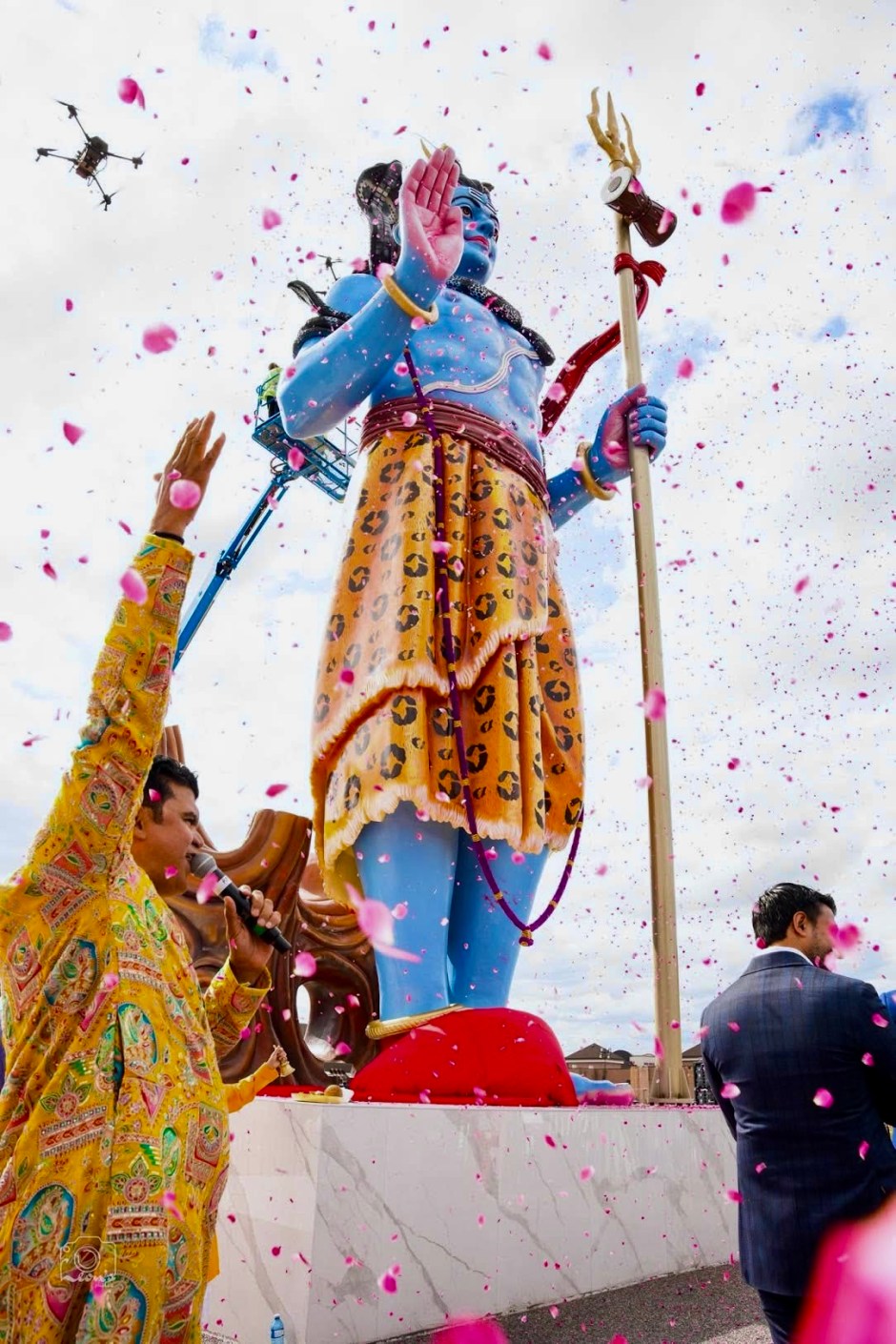
When an imposing Hindu statue was erected in Brampton, Ontario in September 2025, it aroused feelings of pride in some, anger in others.
By Sandhya Maharaj
The first thing I noticed was its height.
A towering statue stood hidden beneath a large red sheet, swaying gently in the cool September 6 breeze on the grounds of Brampton’s Hindu temple, Bhavani Shankar Mandir. A wide concrete courtyard, built to hold the statue, was filled with people standing shoulder to shoulder. Some leaned forward while others held their phones high above their heads, waiting for the moment the covering would fall.
Protective black metal fencing framed the statue’s base, sunlight glinting off a plaque proudly listing the names of the bronze, silver, gold, and platinum sponsors who had helped bring Pandit Hardat Ashwar’s vision to life. To the left, a stage faced opposite the entrance of the temple, its doors opening and shutting as visitors rushed to join the congregation. Sitting in the front row was Brampton’s mayor, Patrick Brown, and other city officials, present to mark the occasion alongside the Hindu community.
Ashwar, 47, the head priest and founder of Bhavani Shankar Mandir, stood at the front of the fenced base, taking in the scene he had imagined for years. Earlier that afternoon, at 1:30, over 300 people walked the streets of Brampton in a procession, making their way from Castlebrooke Secondary School to the temple. The half-hour walk was filled with music and singing, as bright orange flags waved high in the wind. Though the temperature hovered around 18° C, the wind made the afternoon feel much cooler, but the chill did nothing to slow the excitement of those parading down The Gore Road.
As they made their way onto the temple grounds, attendees were met with the sound of pounding drums, volunteers offering free snacks and water, and even more attendees awaiting the unveiling—a steady flow that would eventually reach nearly ten thousand people, according to Ashwar. I slipped toward the back of the crowd, finding a spot that gave me a comfortable, unobstructed view of the main attraction.
“I always dreamt of the day I would block off the roads in Brampton,” Ashwar said. “I always thought it would be cool to get the police to lead the Hindus in a yatra, in a pilgrimage. I always thought it would be cool to have the [Minister of International Trade], Maninder Sidhu, with us today. And I always thought it would be amazing to have all of you with us today.”
The red sheet began to fall as two drones flying above released pink rose petals, showering the fully revealed 54-foot-tall Shiva statue—a Hindu deity understood to be the creator and destroyer. The crowd erupted into chants of “Har Har Mahadev,” a famous invocation meaning “Hail Shiva,” praising the Hindu god.
Ashwar had first established Bhavani Shankar Mandir as a Hindu temple in 2007, starting in a small unit on Melanie Drive on the east side of Brampton; as more people began attending, he quickly realized the temple needed a larger space.
“The community was growing,” he said. “We didn’t have the space to conduct classes or the facilities for [worship].”
In February 2016, the temple relocated to its current location on Nexus Avenue. From a modest 4,000-square-foot unit to 3.5 acres of land, Bhavani Shankar Mandir’s expansion reached its dramatic peak with the unveiling of the Shiva statue.
But even as thousands gathered to celebrate what felt like a triumph of visibility, the unveiling of the Hindu monument sparked online criticism, exposing tensions in Canada’s multicultural landscape. While some saw it as a display of cultural pride, others questioned its place in North America.
It was a historic moment for Canada’s Hindu community, particularly the Guyanese Hindus who had supported Bhavani Shankar Mandir since its humble beginnings nearly two decades earlier. Built by what Ashwar described as a largely Guyanese following, the Sunday morning congregation was often made up of Guyanese and some Trinidadian Hindus (Indo-Caribbeans). Since moving to a larger site, however, it also drew regular visitors from East Indian and Sri Lankan communities.
For many, the inauguration offered a moment of resilience and pride; a reminder, Ashwar said, “when ordinary people come together, they can do extraordinary things.”
The celebration brought together a diverse assembly, with the Hindu community at the forefront, highlighting the strength of the GTA’s broader Indo-Caribbean population. According to Statistics Canada’s 2021 Census, this community of roughly 7,010 is comprised of Hindus, Christians, Muslims, and others.
“This is a venue that will bring people together – North Indians, South Indians, Indo-Caribbeans, Sri Lankans, people from all backgrounds,” Ashwar said.
Videos posted on TikTok and Instagram were meant to highlight the event and the statue, but amid a supportive surge of comments, a steady stream of hate emerged. Some people expressed their unease with a Hindu statue being publicly showcased in what they believed was a Christian country, as well as their expectation for immigrants to assimilate.
On October 16, just over a month after the grand inauguration, TikTok content creator Ayushi Singhal posted a 17-second video publicizing “Ontario’s hidden gem”—the tallest Mahadev statue, referring to Shiva by one of his many epithets, meaning “Great God.” Her video caught the attention of over eighty thousand viewers and attracted more than 1,700 comments, including praise and criticism.
Among the wave of responses, @sneakysnowback (real name unknown) argued that immigrants should conform to their host country: “You’re supposed to assimilate into the country that let you in, not change it into the country you’re trying to get away from.”
But what is assimilation? Founder of the Hindu Lifestyle platform and first-generation Indo-Caribbean Canadian, Shawn Binda, found it difficult to answer this question as he reflected on a conversation he had earlier in the year on X (formerly Twitter).
“There was a video circulating [online] of Hindus publicly performing puja,” Binda said, showing visible disappointment. An X user had commented that acts of puja, a form of worship where a physical representation of Hindu gods are honoured with offerings of flowers and fruits, did not align with the Canadian identity, and that Hindus needed to assimilate. “I wrote back, ‘What does it mean to assimilate? I am Hindu. I was born and raised in Canada. I went to a Catholic school. I celebrate Christmas. And last year, Halloween fell on Diwali,’” his voice exasperated. “My family performed Diwali puja that day, and then I took my kids trick-or-treating [in the evening]. Are you going to tell me I did not assimilate? What does assimilation mean for you?’”
Comments like these dismiss a fundamental part of Canadian identity. In section 2(a) of the Canadian Charter of Rights and Freedoms—freedom of religion—every person has the right to hold and express their own beliefs, and to participate in religious practices publicly or privately without reprisal.
For Brampton’s mayor, Patrick Brown, 47, the city of Brampton encompasses a wide range of cultures and faiths. He frequently attends community events like Bhavani Shankar Mandir’s inauguration, reflecting his belief that religious freedom and faith communities are a force for good in the city.
“I will step in to make sure that every faith community [is given] the same rights and is treated the same,” Brown said when reflecting on the hate South Asians have been receiving.
Another misconception that surfaced online involved the cost of the statue, with several commenters, such as @haydn44fitness (real name unknown), assuming taxpayer money had been used to fund the project. The commenter shared his concern on Singhal’s TikTok on October 23: “I thought this was Canada? I pray tax dollars didn’t go towards this or we need to stop paying our taxes altogether.”
As it turned out, the statue’s installation had been privately funded by the Hindu community through fundraising initiatives held in May 2024 and May 2025, which brought together temple members, local supporters, and donors committed to creating a Hindu landmark in the GTA.
“We had to raise a lot of money,” Ashwar said. “The entire project probably cost us a little more than $1.3 million. When we first began…we decided not to borrow money or use money from the temple’s savings, so we had to do a lot of fundraising.”
Still, members of the Hindu temple chose not to treat the constitutional protection as blanket permission. Instead, they connected with city officials, presenting them with detailed project plans to ensure the statue’s installation aligned with municipal expectations and legal requirements.
“The city was fully supportive of the project,” Ashwar said. “After submitting the project’s plans, we met with the mayor and reached out to our city councillors. We wanted to make sure we were doing things correctly. The city had no problem approving the zoning and the statue’s height for us. Everything was done legally.”
In addition to the financial support, the inauguration was supported by a strong turnout of over 150 volunteers.
Nikhil Siripaul, 16, was one of many volunteers helping to keep the day running smoothly. A Grade 11 student at Castlebrooke Secondary School, he spent the inauguration guiding guests around the temple grounds, assisting his parents with setting up the first aid centre, and bringing in food and drinks. He also participated in several performances, including dances and a traditional drumming set, with 50 others, on the tabla, an Indian drum.
“I thought it would be a good way to give back to the community and be a part of something so important and monumental,” Siripaul said. He first began attending the temple just over two years ago, quickly becoming an active member of the Youth Group and regularly assisting with the audio and visuals for the temple’s live streams.
As he learned about Ashwar’s Shiva statue project, Siripaul felt a sense of excitement and pride. “It’s not every day something this meaningful gets built in our community,” he said. “It was such a proud and massive moment for Hindus.”
Ashwar’s desire to install a 54-foot-tall Shiva statue began long before the temple’s move 10 years earlier; he wanted a landmark capable of stimulating discussions about Hinduism among the young.
“I thought of this as an opportunity to let young people have something to be proud of,” he said, having found that each generation formed its own relationship with the culture. “The younger folk want things. They want art, landmarks…they want to stand out.”
But standing out meant anticipating criticism from the wider community, something Ashwar acknowledged and expected, given the growing hostility toward Indian immigrants in Brampton, a city famous for housing a large South Asian population.
Last April, a neighbouring temple, Hindu Sabha Mandir, installed a 55-foot Hanuman statue, which also sparked backlash on social media. During the statue’s installation, criticism spread beyond social media, with complaints reaching local authorities. Yet, like Bhavani Shankar Mandir, the project was funded by community donations, was built on temple grounds, and complied with municipal regulations.
The growing hostility toward Hindus and South Asians in Brampton prompted Ashwar to reflect on the city he moved into more than 20 years ago, comparing it to his childhood in Guyana. “Before Brampton was dominated by the South Asian community, it was very mixed with many races and religions,” he said. “Interacting with other religions back then has helped me really understand that, at the end of the day, we have the same goal. We’re just doing it differently.
“In Guyana, we only had three major religions, Hinduism, Christianity, and Islam. And while the people were very close, [religious] leaders were very divided. [In Canada], I noticed the leaders are close, but the people are very divided.”
To diminish the division Ashwar exposed, Brown has launched an interfaith council, where leaders from different faiths would meet regularly. “I think talking to [other faiths] is the basis of encouraging respectful dialogue [between communities],” Brown said. “But I also think it’s our duty to stick up for one another. When hate comes, and it will, and there’s some bigoted remark, we denounce it together.”
Nadira Suckoo, 26, a Christian-Jamaican Canadian and an attendee at the inauguration, said that Canadians of Western religions may have a misunderstanding of Hinduism because of differences in how they worship: “At least coming from Pentecostal Caribbean Christians, we don’t really focus on elaborate places of worship or statues, which might be because Pentecostal Christians are more popular in areas where slavery was pronounced. Our primary goal was to become a very righteous and spiritual being.”
Having grown up in the diverse small town of Malton, Ontario Suckoo’s childhood was filled with friends whose families ate different foods, spoke different languages, and practiced different religions. Her upbringing didn’t just expose her to diversity, it also taught her to expect it, value it, and feel a sense of safety within it.
“It’s easy to villainize something you don’t know anything about,” she said. “But if [people] took a couple of seconds to learn the significance of things, they’d realize we’re all on the same page.”
She heard of the Shiva statue event from friends and decided that attending would be a great way to show support. Her previous experiences attending Hindu events, such as Diwali celebrations, had always left her feeling welcome and included. She viewed these events as opportunities to learn more about the differing cultures around her.
When she later learned of the negative comments circulating online, she felt disheartened that such hostility existed in a region she associated with diversity and openness. To her, the GTA was a place where cultural differences should bring people together, not drive them apart.
One comment that caught her attention read, “Canada is being invaded through immigration, disgusting,” posted by Sudbury resident Boston Blacklock.
“I wouldn’t call those comments ignorance,” Suckoo said. “Ignorant comments come from a place of not knowing, but these depict prejudice; people just don’t like [the statue] or want it here.”
She wondered why people choose to post negative comments on things they don’t know about. “I understand why they may feel frustrated, but going online to vent is never the best idea,” she said. “The internet has become this boiling pot of hate—people aren’t there to debate with an open mind; they’re there to spew whatever harmful opinions they want. I doubt the same commenters would show up to an event and say these things out loud. They know the repercussions, and they know what they’re saying is morally wrong. It’s just easier to get away with it online.”
With Canada’s history in mind, Brampton’s mayor considered comments like Blacklock’s as bigoted. “There’s no contradiction in being fiercely proud of your ancestry, your heritage, and your history, and at the same time, being fiercely proud to be Canadian. There is no contradiction in loving where you came from and loving where you are,” he said. “And, unless you’re Indigenous, everyone has come from somewhere else, and we should learn about each other’s journeys—not let it be a reason for division.”
Most comments came from users with private profiles; attempts to reach their authors went unanswered, confirming Suckoo’s opinion that online anonymity lets people spread harmful opinions without facing consequences.
“Everyone will always have an opinion about [something],” 16-year-old Siripaul said. “But there should be mutual respect and understanding for one another.”
Being a Canadian Hindu, Siripaul understood the importance of respecting his cultural roots while embracing the values and opportunities Canada provides: “Our culture is who we are, and this [statue] will be here for a long time.”
Like Siripaul, Ashwar acknowledged that no act in a country like Canada could satisfy everyone. “The people making those types of comments don’t even have an identity on social media,” he said.
However, despite the composed stance of Bhavani Shankar Mandir’s leading priest, members of the Hindu community, like Shawn Binda, refused to remain silent and responded to public hostility by attempting to educate them. “I try not to take the comments too seriously, but I feel the need to respond because people read the comments. It’s important to show that there are people who disagree with what’s being said and give an alternative view,” he said.
And despite the backlash lingering online, what mattered most was choosing unity over division. Youths like Siripaul will continue to see the 54-foot Shiva statue as a connection between their religion and the wider GTA and as a signifier of identity. “That [statue] is a reminder that our roots are everywhere—not just in India or Guyana. It gives us a visible symbol for our culture in an everyday environment,” Siripaul said.
At the Shiva statue’s grand unveiling, Mayor Brown, City Councillor Rod Power, local police officers, and representatives from various faiths stood alongside the Hindu community, publicly supporting both the statue and the right to practice their religion freely.
“We’ve pushed past the Eurocentric idea of how religion is supposed to appear,” Suckoo said. “That’s why I appreciated Mayor Patrick Brown’s speech, especially when he pointed out that it would not be fair to limit [Hindus] based on a mould that was never made for them.”
Standing on stage in front of all the attendees, Brown described his attendance at the unveiling as an honour, voiced his pride in supporting the Hindu community, and spoke of the hypocrisy in the treatment of religious expression.
Brown, who had received complaints and seen criticism of the statue’s installation online, said, “In Brampton, we are proud of religious freedom [and] treat all faiths the same. If there were a giant cross—and there are on many churches—[people] would not object. If a Hindu [temple] wants to have a beautiful statue of Shiva, it would be hypocritical and dishonest to say anything other than congratulations on the growth of Bhavani Shankar Mandir.”
The mayor’s words carried beyond the podium that evening, offering more than just political reassurance. He affirmed a certain vision of Brampton and the wider GTA that allows faiths to be visible, cultures to be lived, and traditions to be shared without apology.
The Shiva statue, standing tall on Bhavani Shankar Mandir’s grounds, will forever be a symbol of one truth: integration can exist without compromise, and faith does not need to be compromised to belong in a country.
Sandhya is a freelance writer and can be reached at sandhya_maharaj@hotmail.com

